
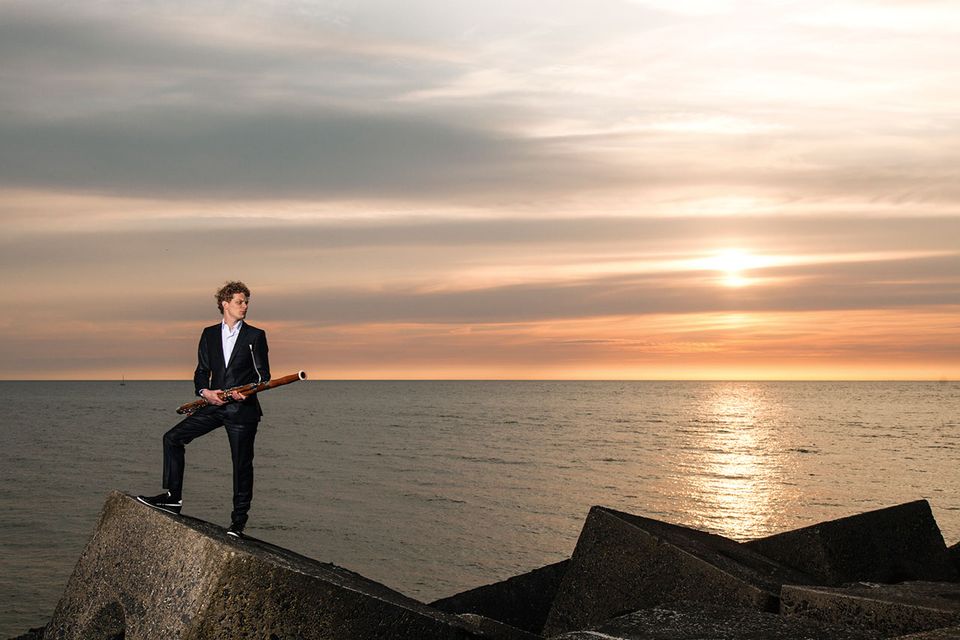
The Endless Possibilities of Sound with Bassoonist Bram van Sambeek
Friday 30 October
Bassoonist Bram van Sambeek knows no musical boundaries. As the only bassoonist ever to receive the Dutch Music Prize, he has transformed the possibilities of his instrument. In his programme Roots, Van Sambeek reveals the remarkable expressive range of the bassoon. Experience its seemingly endless palette of sounds at Pakhûs SOLO on Friday evening, 30 October.
From newly commissioned works and classical masterpieces to jazz, Arabic music and even heavy metal, Bram van Sambeek embraces every musical style with remarkable versatility. For Roots, he brings together three important contemporary compositions, each paired with related works from the classical repertoire.
Woodlands, by Finnish composer Sebastian Fa…
Bassoonist Bram van Sambeek knows no musical boundaries. As the only bassoonist ever to receive the Dutch Music Prize, he has transformed the possibilities of his instrument. In his programme Roots, Van Sambeek reveals the remarkable expressive range of the bassoon. Experience its seemingly endless palette of sounds at Pakhûs SOLO on Friday evening, 30 October.
From newly commissioned works and classical masterpieces to jazz, Arabic music and even heavy metal, Bram van Sambeek embraces every musical style with remarkable versatility. For Roots, he brings together three important contemporary compositions, each paired with related works from the classical repertoire.
Woodlands, by Finnish composer Sebastian Fagerlund, was written especially for Van Sambeek. Inspired by the bassoonist's spectacular virtuosity and refined musicianship, Fagerlund created a work that unfolds like a mysterious forest, where musical ideas move, interact, transform and gradually evolve. Rich, resonant bassoon tones, shimmering overtones and expressive vibrato create an immersive sound world in which past and present seem to coexist.
The more contemplative Pieskārieni (Touches) by Latvian composer Pēteris Vasks was originally written for oboe. Van Sambeek arranged the work for bassoon last summer during the Stift Festival, in collaboration with the composer, to celebrate Vasks' 80th birthday. Deeply rooted in nature, Vasks' music is imbued with a profound sense of spirituality. For him, music is more than an art form – it is a necessity, a response to violence, loss and the dehumanisation of society.
In Monologue for Bassoon, by Isang Yun, Van Sambeek quite literally demonstrates his extraordinary breath control. Yun's Hauptton technique is based on long, sustained notes that continuously change in colour, dynamics and vibrato. Inspired by traditional Korean wind instruments, the work creates the illusion of an uninterrupted stream of sound. Demanding rapid passages, wide leaps and the use of circular breathing make it one of the most technically challenging works in the bassoon repertoire.
For many years, Bram van Sambeek was principal bassoon of the Rotterdam Philharmonic Orchestra and guest principal bassoon with the London Symphony Orchestra, before dedicating himself entirely to a career as a soloist and chamber musician. He performs internationally and has inspired numerous composers to write concertos especially for him. A true musical innovator, his career ranges from a solo Bach recording for BIS Records to a rock album with ORBI (The Oscillating Revenge of the Background Instruments), the ensemble he founded himself.
The concert lasts approximately one hour and is performed without an interval. Coffee or tea is served before the concert, followed by a complimentary drink afterwards.
Programme curator Beate Loonstra says:
"It was high time for Pakhûs SOLO to bring the bassoon back into the spotlight! The theme of this season's solo series is 'Revealing the Colours of Sound', and Bram van Sambeek embodies that idea perfectly. His exceptional command of phrasing, tone colour and physical virtuosity makes him a truly remarkable musician. What he achieves on the bassoon is simply unparalleled."